
Where is the Balmoral driving test centre?
The Balmoral centre sits at 66 Balmoral Road, Malone Lower, Belfast BT12 6QL — just off the Lisburn Road/Boucher Road corridor in south Belfast, close to the King’s Hall site and Musgrave Park. It’s one of the busiest centres in the DVA’s Northern Ireland network, serving candidates from south and west Belfast, Finaghy, Dunmurry, Andersonstown, Stranmillis, the Malone Road area and beyond.
The location shapes the test from the first minute: Balmoral Road connects two of south Belfast’s heaviest traffic environments — the Boucher Road retail and industrial estate on one side and the Lisburn Road on the other — with the Stockman’s Lane junction of the M1 minutes away. There is no gentle warm-up here; you’re in real traffic almost immediately.
Arrive at least 15 minutes early with your provisional licence and your theory test pass certificate if requested, and make sure your vehicle displays L-plates front and rear.


Are belfast balmoral driving test routes officially published?
No. The DVA does not publish official test routes for Balmoral or any Northern Ireland centre, and examiners vary routes on the day. But tests must stay within practical reach of the centre, and local instructors have documented a consistent set of route variations working three broad corridors: south Belfast (Lisburn Road, Malone, Stranmillis, Annadale Embankment), the Boucher/Finaghy corridor (Boucher Road, Tates Avenue, Finaghy Road North, the A55), and west Belfast (Stewartstown Road, Andersonstown, Dunmurry).
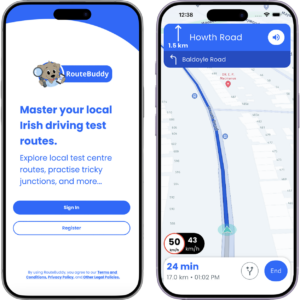
So the preparation rule is the same one that works everywhere: don’t memorise a single route — master the environments every variation draws from. That’s the model Routebuddy is built on: drive every documented variation until no junction in south or west Belfast is unfamiliar.
The roads that make up the Balmoral test routes
| Road / area | Type | What it tests |
|---|---|---|
| Balmoral Road & the centre exit | Busy connector between two traffic zones | Moving off, observation, immediate traffic |
| Boucher Road & the retail estate | Heavy commercial traffic, multi-lane junctions | Lane discipline, gap judgement, patience |
| Lisburn Road | Dense urban artery — shops, crossings, buses | Pedestrian scanning, speed management, progress |
| Malone Road, Balmoral Avenue & Cranmore Park | Leafy residential streets, parked cars | Manoeuvres, clearance, meeting traffic |
| Stranmillis & Annadale Embankment | Riverside roads and junctions | Positioning, roundabouts, cyclists |
| Tates Avenue & the Village streets | Tight terraced grid | Narrow-road judgement, priority decisions |
| A55 Outer Ring | Dual carriageway | Merging, lane changes, higher-speed driving |
| Stockman’s Lane & Musgrave Park area | Major junction complex feeding the M1 | Early lane commitment, sign reading |
| Finaghy Road North & the crossroads | Busy suburban junctions, rail bridge | Traffic-light discipline, right turns |
| Stewartstown Road, Andersonstown & Dunmurry | West Belfast arterials and estates | Speed transitions, junctions, estate driving |
A typical Balmoral route runs around 40 minutes of driving, blending at least two of the three corridors — commonly Boucher/Lisburn Road work plus either a south Belfast residential loop or a west Belfast leg, with a stretch of the A55 in between.
The most common fail spots on belfast balmoral driving test routes
- The Boucher Road estate. Retail traffic, delivery lorries, multi-lane junctions and constant lane merges. The twin faults: drifting between lanes without mirror checks, and hesitating at busy exits until the examiner notes a progress fault. Pick your lane early, check, commit.
- The Lisburn Road’s crossings and buses. One of Belfast’s busiest shopping streets — pedestrian crossings every few hundred metres, buses pulling in and out, cars emerging from side streets. Passing a stopped bus without scanning for pedestrians is a classic serious fault here.
- Stockman’s Lane. The junction complex feeding the M1 is heavily signed, multi-laned and fast. You won’t be taken onto the motorway — learner drivers can’t use motorways in Northern Ireland — but routes skirt this junction, and late lane changes or sign misreads are regular test-enders.
- The A55 Outer Ring. The dual-carriageway section demands confident merging and clean lane changes at speed — while never exceeding 45 mph, the legal maximum for learners in Northern Ireland regardless of the posted limit. Balancing decent progress against that ceiling is a skill in itself: hold 45 where the limit is higher and traffic is faster, and don’t be bullied above it.
- The Malone and Stranmillis residential streets. Parked cars on both sides, tight corners and driveways. This is manoeuvre country — the reverse, the turnabout — and clearance judgement past parked vehicles is marked constantly. Around a metre’s gap, decisive give-and-take, no mid-road hovering.
- Finaghy crossroads. A busy signal-controlled junction with a railway bridge nearby. Creeping over stop lines, late amber decisions and blocked junctions are the standard faults.
- The west Belfast leg. Stewartstown Road and the Andersonstown arterials mix fast traffic with school zones and dense crossings; speed-limit transitions come quickly, and prompt adjustment in both directions is expected.
- The last five minutes. The return along Balmoral Road, back through the traffic you started in, catches candidates who’ve mentally finished. The test ends in the centre car park, not before.
How the DVA driving test is marked
The Northern Ireland practical test differs from the Republic’s RSA test — if you’re comparing across the border, note the terminology and format change. At Balmoral you’ll get:
- An eyesight check — reading a number plate from 20.5 metres. Fail this and the test ends immediately.
- Vehicle safety questions — one “show me” and one “tell me” question about your car.
- Around 40 minutes of driving, including roughly 20 minutes of independent driving following traffic signs or a series of directions.
- One reversing manoeuvre — parallel parking, reversing into a bay, or reversing around a corner — plus a possible emergency stop.
Faults are recorded in three grades: driving faults (minor — but 16 or more fails the test), serious faults and dangerous faults (one of either is an automatic fail). The heavy fault categories at Balmoral mirror its roads: observation at junctions, mirror use on lane changes, and appropriate speed.
After you pass, Northern Ireland’s rules keep working: you must display R-plates (restricted driver plates) for one year and observe the 45 mph maximum throughout that period.
Balmoral driving test pass rate
Figures compiled from DVA data have put Balmoral’s pass rate around the mid-40s per cent in recent years — towards the tougher end for Northern Ireland, which is unsurprising for a centre whose routes are almost entirely urban and traffic-dense. Exact figures move year to year and by test category; for current statistics, check the DVA’s published data via nidirect and the Department for Infrastructure’s driver testing statistics.
The pattern behind the number is familiar: candidates who trained on quiet roads meet Boucher Road traffic for the first time on test day. The fix is equally familiar — practise where the test actually happens.
How to practise the Balmoral routes effectively
- Start with the centre’s own doorstep. The Balmoral Road exit and its junctions with the Lisburn Road and Boucher Road, repeatedly, at test-slot times of day.
- Do dedicated Boucher sessions. Weekday retail traffic, every major junction, both directions — until lane choice is automatic.
- Ride the Lisburn Road at peak. Crossings, buses, side streets. Build the scanning rhythm the road demands.
- Practise the A55 at 45. Merging and lane-changing on the Outer Ring while holding the learner limit — awkward at first, essential on the day.
- Manoeuvre in Malone. The reverse and turnabout on real corners around Balmoral Avenue and Cranmore Park, with parked cars and driveways in play.
- Add a west Belfast loop weekly. Stewartstown Road’s speed transitions and school zones round out the full route repertoire.
- Finish with full 40-minute mock tests from the centre, including an independent-driving section following signs. Routebuddy’s Balmoral routes let you drive every documented variation turn by turn until south and west Belfast feel like home ground.
Practise legally: in Northern Ireland a learner must be supervised by someone who is at least 21 and has held a full licence for the category for at least three years, L-plates must be displayed front and rear, the 45 mph limit applies at all times, and motorways are prohibited.
Booking your test and what to bring
Book through the DVA’s practical test booking service on nidirect. Waiting times vary with demand and season — check the booking system regularly, as cancellation slots appear at short notice.
On the day: your provisional licence, a roadworthy, insured car with a valid MOT (if applicable) and L-plates front and rear. If you’re using your own car rather than an instructor’s, confirm it meets the DVA’s test vehicle requirements in advance — tests are cancelled, with the fee lost, for non-compliant vehicles.
Frequently asked questions
Where is the Balmoral driving test centre?
At 66 Balmoral Road, Malone Lower, Belfast BT12 6QL — between the Boucher Road estate and the Lisburn Road in south Belfast. It’s a DVA (Driver & Vehicle Agency) centre, the body that runs driving tests in Northern Ireland.
How many Belfast Balmoral driving test routes are there?
The DVA doesn’t publish official routes, but local instructors have documented a consistent set of variations working three corridors: south Belfast (Lisburn Road, Malone, Stranmillis), the Boucher/Finaghy corridor and the A55, and west Belfast via the Stewartstown Road.
What is the pass rate at Balmoral test centre?
Figures compiled from DVA data have put Balmoral around the mid-40s per cent in recent years — towards the tougher end for Northern Ireland, reflecting its dense urban routes. Check the DVA’s current statistics via nidirect for the latest figures.
How long is the driving test at Balmoral?
Around 40 minutes of driving, including an eyesight check beforehand, one “show me” and one “tell me” vehicle safety question, roughly 20 minutes of independent driving, and one reversing manoeuvre with a possible emergency stop.
Does the Balmoral test go on the motorway?
No — learner drivers cannot use motorways in Northern Ireland. Routes do use the A55 Outer Ring dual carriageway and skirt the Stockman’s Lane junction of the M1, so merging and lane discipline at speed are still tested — within the learner’s 45 mph limit.
What speed can a learner driver do in Northern Ireland?
A maximum of 45 mph at all times, regardless of the posted limit — a rule unique to Northern Ireland. It continues for a year after you pass, while you display R-plates as a restricted driver.
What is the hardest part of the Belfast-Ballymena driving test routes?
Candidates most often cite the Boucher Road estate’s lane discipline, the Lisburn Road’s crossings and buses, and the signed multi-lane approaches around Stockman’s Lane. The consistent theme is heavy, fast-moving urban traffic from the first minute.
Can I practise the exact route I’ll get on the day?
No — examiners vary routes deliberately. Practise all the documented variations rather than memorising one. That’s the approach Routebuddy takes: every documented Balmoral variation, drivable turn by turn.
This guide is published by Routebuddy as an independent resource for learner drivers and is not affiliated with the Driver & Vehicle Agency (DVA) or the Department for Infrastructure. Route details reflect roads commonly reported by local instructors and learners; actual test routes vary at the examiner’s discretion. Always verify current rules, fees and requirements on nidirect.gov.uk.