
Where is the Newcastle West (Intreo Centre) test centre?
The centre operates from the Intreo Centre building at Gortboy, Newcastle West, Co. Limerick — just off the N21 on the eastern side of town. It serves learners from Newcastle West itself and a wide rural catchment: Abbeyfeale, Ardagh, Rathkeale, Dromcollogher, Broadford, Athea, Templeglantine and much of west Limerick.
Two local facts matter before anything else. First, Newcastle West has two RSA test venues within about 400 metres of each other — the Intreo Centre at Gortboy and the Longcourt House Hotel on the edge of town. They are separate listings with separate pass-rate records, and candidates have arrived at the wrong one. Your RSA booking confirmation names your venue; read it twice.
Second, Newcastle West has often carried some of the shortest waiting times in the region, which makes it a popular booking for candidates from Limerick city willing to travel — the RSA even allows you to switch centres to chase shorter queues. If that’s your plan, budget real practice time here first: this test rewards local familiarity more than most, because its roads are unlike the city’s.


Are Newcastle West test routes officially published?
No. The Road Safety Authority (RSA) doesn’t publish official routes for Newcastle West or any Irish centre, and testers vary routes on the day. Local instructors have documented roughly five regularly used route variations from the Intreo Centre — but don’t let the small number fool you. Routes here are long by national standards, often covering 20 km or more, because so much of the drive happens on open rural roads at higher speeds.
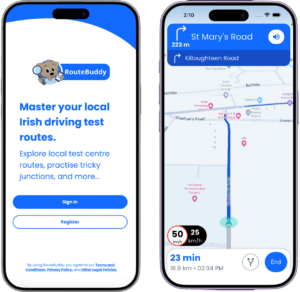
The preparation logic is the same as anywhere, sharpened: don’t memorise turns — master the three environments (town, N21, rural lanes) that every variation combines. That’s the model Routebuddy is built on: drive every documented variation until each environment feels routine.
The roads that make up the Newcastle West test routes
| Road / area | Type | What it tests |
| Sheehan’s Road & Gortboy | Centre exit and town approach | Moving off, observation, positioning |
| The N21 through town | National primary — heavy Limerick–Kerry traffic, HGVs | Right turns across traffic, roundabouts, progress |
| Cork Road (R522) & the N21 roundabouts | Regional road and junctions | Roundabout technique, lane discipline |
| R520 (Dromcollogher road) & R521 (Church Street/Ardagh road) | Regional roads leaving town | Building to open-road speed, overtaking judgement |
| Bishop Street, Church Street & the town centre | Narrow town streets, parked cars, pedestrians | Clearance, patience, priority judgement |
| Station Road & Templegreen | Residential streets | Manoeuvres, speed control |
| Killeline, Killeline Heights & Knockane Road | Rural-edge estates and lanes | Reverse, turnabout, hill start, narrow-road driving |
| Ballygeel, Moanleana, Treanboy & the L-roads (L1305, L1315, L1321) | Genuine country roads — narrow, unmarked, hedge-lined | Speed judgement, meeting traffic, road position without markings |
| Bóthar Buí & St Ita’s Road | Connecting roads back to the N21 | Junctions onto fast roads, observation |
A typical Intreo Centre route runs 20–26 km with 30–35 minutes of driving — out through Gortboy, onto or across the N21, a long rural loop through the Killeline/Knockane or Ballygeel lanes, and back through the town centre streets to Sheehan’s Road.
The most common fail spots on Newcastle West test routes
- The right turn onto the N21. The signature moment of this test. The N21 carries constant car and HGV traffic between Limerick and Kerry, and routes join or cross it several times. Judging gaps across two fast streams — decisively but safely — is the skill that decides more results here than any other. Above all, never creep into a half-gap; never sit frozen through three good ones.
- Speed management on the rural lanes. On unmarked country roads the tester expects appropriate speed, not maximum speed: the limit may say 80 km/h, but a hedge-blind bend or a crest says otherwise. As a result, driving the limit into blind bends is marked as a serious hazard fault; crawling on open straights costs progress. Reading the road is the test.
- Meeting traffic on single-width stretches. Hedge-lined lanes with no centre line mean real decisions when a tractor, jeep or school bus appears: who yields, where’s the passing space, how far do you reverse? Testers watch for calm, decisive cooperation — panic stops in the middle of the lane are faults.
- Road position without markings. With no white lines, learners drift — toward the centre on bends, toward the verge on straights. Hold a consistent position, off the verge grass and clear of the centre, adjusting early for bends.
In town, on the roundabouts and during manoeuvres
- The town-centre streets. Bishop Street and Church Street are narrow, parked-up and busy with pedestrians and delivery vans. Clearance judgement and patience behind stopped vehicles — without hovering indefinitely — are marked closely.
- The N21 roundabouts. Between town and the Cork Road, the roundabouts carry fast national-road traffic. Standard technique applies, but entries are quicker than they look; match the speed of the flow.
- The manoeuvres. The reverse around a corner, turnabout and hill start are usually done in the quieter residential streets around Killeline Heights, Templegreen and off Station Road. Rural-edge corners come with slopes and loose surfaces — practise on the real thing.
- Speed-limit transitions at the town boundary. Routes cross the 50/80 (and sometimes 100) km/h boundaries repeatedly. Prompt, visible adjustment in both directions — including building up to open-road speed when the limit rises — is expected every single time.
How the Irish driving test is marked
Newcastle West follows the standard RSA category B format: road-sign and rules-of-the-road questions at the desk, under-bonnet technical checks, a check of your insurance disc, tax, NCT, lights and indicators, secondary controls, then 30–35 minutes of driving including a reverse around a corner, a turnabout and a hill start.
Faults are graded three ways:
- Grade 1 — minor; no effect on the result.
- Grade 2 — more serious. Four of the same grade 2 fault, six in one section, or nine in total is a fail.
- Grade 3 — dangerous or potentially dangerous. One is an automatic fail.
In summary, the Newcastle West-typical fault clusters: progress (hesitancy at the N21 and over-cautious rural speeds), reaction to hazards (blind bends, meeting traffic), position (unmarked roads), and observation (junctions onto fast roads).
Newcastle West driving test pass rate
The Intreo Centre has typically tracked right around the national average — in the most recent full-year figures published by the RSA, Newcastle West recorded 53.6% against a national average of 53.2%, while the neighbouring Longcourt House Hotel venue posted a notably higher 59.7%, among the better rates in the country.
Combine near-average pass rates with historically short waiting times and Newcastle West is one of the smartest bookings in the mid-west — provided you respect what makes it different. In particular, city-trained learners who arrive without rural-road practice are exactly the candidates who drag the average down. However, pass rates change every year: check the RSA’s driving test pass rates page for the current figures.
How to practise the Newcastle West routes effectively
- First, log rural hours. This is the preparation most candidates lack. Drive the Killeline, Knockane and Ballygeel lanes repeatedly: position without markings, speed into blind bends, and meeting oncoming traffic calmly.
- Drill the N21 entries. Right turns onto and across the N21 from every junction the routes use, at school-run and freight-heavy times. Decisive gap-taking is a trainable habit.
- Practise rural meets deliberately. Seek out tractors and wide vehicles; rehearse yielding, using gateways as passing spaces, and reversing to a passing point under no pressure.
- Walk-then-drive the town centre. Bishop Street and Church Street at busy times: clearance past parked vans, pedestrians, and patient-but-purposeful progress.
- Do manoeuvres on rural-edge corners. Killeline Heights and Templegreen corners with slopes and kerbless edges — the real conditions, not a car park.
- Rehearse the boundary transitions. Every practice run should cross the 50/80 km/h boundary several times, with prompt adjustment both ways.
- Finish with full mock tests. Complete 35-minute simulations from Gortboy, mixing documented variations — each one combining town, N21 and rural segments. Routebuddy’s Newcastle West routes let you drive every documented variation turn by turn until all three environments feel like home.
Practise legally: learners must be accompanied by a qualified driver who has held a full licence for at least two years, and the car must display L plates.
Booking your test and what to bring
Book through the RSA’s MyRoadSafety portal. Waiting times at Newcastle West have often been short — the RSA’s waiting time estimator shows the live picture, and cancellation slots appear at short notice if you check regularly.
On the day: valid learner permit, a roadworthy car with valid NCT, tax and L plates, and — under RSA rules introduced in 2026 — a valid motor insurance certificate proving you’re covered to drive the test vehicle. No certificate, no test. And once more: confirm which Newcastle West venue your booking names — the Intreo Centre at Gortboy or the Longcourt House Hotel — they’re only 400 metres apart, which makes the mix-up easier, not harder.
Frequently asked questions
Where is the Newcastle West (Intreo Centre) test centre?
At the Intreo Centre building, Gortboy, Newcastle West, Co. Limerick, just off the N21 on the east side of town. Newcastle West has a second RSA venue at the Longcourt House Hotel about 400 metres away — check your booking confirmation for which one is yours.
How many driving test routes are there in Newcastle West?
The RSA doesn’t publish official routes, but local instructors have documented roughly five regularly used variations from the Intreo Centre. They’re long routes — often 20 km or more — combining town streets, the N21 and rural lanes around Killeline, Knockane and Ballygeel.
What is the pass rate at Newcastle West test centre?
In the most recent full-year RSA figures, Newcastle West (Intreo Centre) recorded 53.6% — essentially the national average of 53.2% — while the Longcourt House Hotel venue posted 59.7%. Check the RSA statistics page for the latest year’s figures.
Is Newcastle West an easy place to do the driving test?
Its pass rate sits around the national average and waiting times have often been short, which makes it a smart booking. But the test is genuinely different: rural, unmarked roads and N21 gap judgement fail city-trained candidates who haven’t practised locally.
What is the hardest part of the Newcastle West driving test?
The right turn onto the N21 across fast two-way traffic is the most cited single moment. Across the whole test, speed and position judgement on narrow, unmarked rural roads — including meeting oncoming tractors and buses — is what separates passes from fails.
Where are the manoeuvres done on the Newcastle West test?
The reverse around a corner, turnabout and hill start are usually carried out in quieter residential streets around Killeline Heights, Templegreen and off Station Road, sometimes on sloping rural-edge corners.
Can I switch to Newcastle West for a shorter driving test wait?
Yes — the RSA lets you choose or change your test centre, and Newcastle West has often had one of the region’s shorter queues. If you switch, invest in practice on its rural network first; unfamiliarity with unmarked roads is the main reason travelling candidates fail here.
Can I practise the exact route I’ll get on the day?
No — testers vary routes deliberately. Practise all the documented variations rather than memorising one. That’s the approach Routebuddy takes: every documented Newcastle West variation, drivable turn by turn.
