
Where is the Castlemungret driving test centre?
The Castlemungret test centre is located in the Castlemungret Industrial Estate, Dock Road, Limerick (R510 side of the city) — near the docks and Mungret, on the city’s south-western edge. It serves learner drivers from Limerick city, Raheen, Dooradoyle, Mungret, Ballinacurra, Janesboro, Garryowen, Corbally, Castletroy, Annacotty and much of County Limerick.
Two things distinguish it. First, Castlemungret is Limerick’s multi-category centre — as well as car tests, it conducts motorcycle, truck and bus tests, so expect heavy vehicles manoeuvring around the estate and the Dock Road at all hours. Second, Limerick has two RSA test centres about 4 km apart: Castlemungret on the Dock Road and Limerick (Woodview) on the Raheen/Dooradoyle side. Candidates booking “Limerick” sometimes assume there’s one centre and drive to the wrong one — your RSA booking confirmation names the exact centre, so read it twice and scout the location beforehand.
The test’s opening move is its own small challenge: local candidates are routinely advised to treat the exit from the test centre gates as a full junction — proper observation both ways, indicate, and hold a slow, controlled pace through the industrial estate until you reach the Dock Road proper. Faults in the first 200 metres are common and completely avoidable.


Are Castlemungret test routes officially published?
No. The Road Safety Authority (RSA) doesn’t publish official routes for Limerick Castlemungret Driving Test Routes or any Irish centre, and testers vary routes on the day within a practical radius of the centre. Local instructors have documented roughly seven regularly used route variations at Castlemungret, all drawing from the same south-city network.
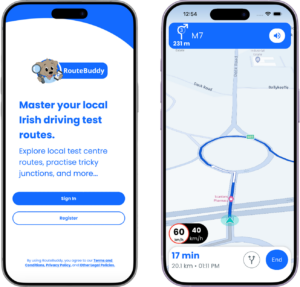
So don’t memorise a single route — learn the network’s hazard types: industrial-corridor traffic, a roundabout-heavy ring road, tight city streets and quiet residential estates, often all in one 35-minute drive. That’s the practice model Routebuddy is built around: drive every documented variation until no junction in the city surprises you.
The roads that make up the Castlemungret test routes
| Road / area | Type | What it tests |
| Dock Road (R510) & its roundabouts | Industrial corridor with HGV traffic | Moving off, roundabouts, lane discipline among trucks |
| Childers Road (R509/R526) ring | Limerick’s roundabout spine — Roxboro, Tipperary roundabouts | Multi-lane roundabout technique, progress |
| Ballinacurra Road & O’Connell Avenue approaches | Busy urban arterials | Positioning, traffic lights, pedestrians |
| Courtbrack Avenue, Ashbourne Avenue & New Street | Residential connectors with mini-roundabouts | Signalling, observation, speed control |
| Hyde Avenue, Carey’s Road & Prospect | Older residential streets, parked cars | Clearance, meeting traffic |
| Roxboro Road (R511) & Janesboro | Distributor and estates | Junction judgement, manoeuvres |
| Dublin Road (R445) & Ballysimon Road (R527) | Faster commuter corridors | Building speed, mirror routine, lane changes |
| St Patrick’s Road, Greenhill Road & Garryowen | Compact residential grid | Tight turns, priority judgement, manoeuvres |
| Old Clare Street, Broad Street & Charlotte’s Quay | Genuine city-centre streets, one-ways and quays | Lane discipline, bus lanes, pedestrian scanning |
| Lower Mallow Street & the Shannonbridge roundabout | City river-crossing junctions | Lane choice, decisiveness in dense traffic |
A typical Castlemungret route runs about 13–14 km with 30–35 minutes of driving — commonly out the Dock Road, through the Ballinacurra or Carey’s Road residential belt, a stretch of the Childers Road ring, a loop through Garryowen or the Ballysimon corridor, then back through or past the city centre to the Dock Road. Routes can also head toward Raheen and Dooradoyle on the centre’s western side.
The most common fail spots on Limerick Castlemungret Driving Test Routes
- The test centre exit and the industrial estate. Treat the gates as a junction: full observation, correct signal, dead-slow through the estate. With trucks turning in and out all day, sightlines change constantly — testers watch your first minute closely.
- The Dock Road roundabouts. The R510 is one of Limerick’s busiest freight corridors. Entering roundabouts alongside HGVs punishes weak gap judgement, and their length means you must not linger beside a truck’s blind side. Decisive, well-positioned entries win here.
- The Roxboro and Tipperary roundabouts on the Childers Road. Limerick’s ring road is roundabout after roundabout, several of them multi-lane. Lane choice on approach, staying in lane through the turn, and the left-signal-on-exit habit are marked relentlessly. This ring is to Castlemungret what the big-name roundabouts are to Dublin centres: the make-or-break skill.
- The city-centre streets. Few Irish test centres send you through genuine city streets. Around Broad Street, Old Clare Street and Charlotte’s Quay, expect one-way systems, bus lanes, pedestrians stepping out, and tight lane widths. Read the road markings early — a wrong lane on a one-way is an instant serious fault.
- Right turns off the arterials. Busy right turns — Ballinacurra Road onto the Childers Road, Ballysimon Road junctions, and the Dublin Road lights — require early positioning, straight wheels while waiting, and patient gap selection without hesitancy creep.
- The residential estates. Garryowen, Janesboro, Prospect and the Carey’s Road streets are where clearance and meeting-traffic decisions happen: about a metre from parked cars, decisive give-and-take, no mid-road hovering. The reverse around a corner, turnabout and hill start are usually done on these quiet corners — practise them there, not in an empty lot.
- Speed-limit transitions. Routes swing from 30 km/h zones through 50 km/h city roads to faster stretches on the Dublin and Ballysimon Roads. Prompt adjustment in both directions is marked — dawdling on the fast sections costs progress faults just as surely as speed in the estates costs worse.
How the Irish driving test is marked
Castlemungret follows the standard RSA category B format: road-sign and rules-of-the-road questions at the desk, under-bonnet technical checks, a check of your insurance disc, tax, NCT, lights and indicators, secondary controls, then 30–35 minutes of driving including a reverse around a corner, a turnabout and a hill start.
Faults are graded three ways:
- Grade 1 — minor; no effect on the result.
- Grade 2 — more serious. Four of the same grade 2 fault, six in one section, or nine in total is a fail.
- Grade 3 — dangerous or potentially dangerous. One is an automatic fail.
The Castlemungret-typical fault clusters: position (ring-road roundabouts and city one-ways), observation (the estate exit and HGV-heavy Dock Road), and progress (hesitancy at busy right turns and roundabout entries).
Castlemungret driving test pass rate
Castlemungret has typically been the friendlier of Limerick’s two centres — and better than the national average. In the most recent full-year figures published by the RSA, Limerick (Castlemungret) recorded a pass rate of 54.9%, against a national average of 53.2%, while Limerick (Woodview) posted 49.3%. Centre-level data compiled since shows Castlemungret continuing to track around or above the norm.
Credit the network: for all its variety, it’s compact and repetitive, and candidates who practise locally recognise the patterns quickly. Don’t mistake above-average for easy — the ring-road roundabouts and city streets punish the underprepared — but focused local practice converts to passes well here. Pass rates change every year: check the RSA’s driving test pass rates page for the current figures before reading too much into any single number.
How to practise the Castlemungret routes effectively
- Rehearse the estate exit. Ten controlled, fully-observed exits through the gates and out to the Dock Road, treating every internal junction as live.
- Make the Childers Road ring your circuit. Loop Roxboro to Tipperary roundabout and back repeatedly, at quiet and busy times, until lane choice and exit signalling are automatic.
- Drive with the trucks. Deliberate Dock Road sessions at freight-heavy times teach the gap judgement and blind-side awareness the test demands.
- Do a city-centre lap weekly. Broad Street, the quays, the one-ways — learn the lane markings before your nerves have to.
- Estate work in Garryowen and Janesboro. Clearance, meeting traffic, and all three manoeuvres on the real corners testers use.
- String the transitions together. Estate → arterial → ring road → city centre in one continuous drive, focusing on prompt speed adjustments at every change.
- Finish with full mock tests. Complete 35-minute simulations from the Castlemungret Industrial Estate, mixing documented variations. Routebuddy’s Castlemungret routes let you drive each one turn by turn until the whole south city feels like home ground.
Practise legally: learners must be accompanied by a qualified driver who has held a full licence for at least two years, the car must display L plates, and learners may not drive on motorways — keep practice to the N/R roads, not the M7/M20.
Booking your test and what to bring
Book through the RSA’s MyRoadSafety portal. Waiting times shift constantly — the RSA’s waiting time estimator shows the live picture for Castlemungret, and cancellation slots appear at short notice if you check regularly.
On the day: a valid learner permit, a roadworthy car with a valid NCT, tax and L plates, and — under RSA rules introduced in 2026 — a valid motor insurance certificate proving you’re covered to drive the test vehicle. No certificate, no test. And confirm which Limerick centre your booking names: Castlemungret on the Dock Road, or Woodview on the Raheen side — they are about 4 km apart.
Frequently asked questions
Where is the Castlemungret driving test centre?
In the Castlemungret Industrial Estate on the Dock Road (R510), on the south-west side of Limerick city, near Mungret. Don’t confuse it with Limerick (Woodview), the city’s second RSA centre about 4 km away on the Raheen/Dooradoyle side — check your booking confirmation.
How many Limerick Castlemungret Driving Test Routes are there?
The RSA doesn’t publish official routes, but local instructors have documented roughly seven regularly used variations, all drawing on the Dock Road, the Childers Road ring, the south-city estates, the Ballysimon and Dublin Road corridors, and the city centre.
What is the pass rate at Castlemungret test centre?
In the most recent full-year RSA figures, Limerick (Castlemungret) recorded 54.9% — above the national average of 53.2% and ahead of Limerick (Woodview) at 49.3%. Check the RSA statistics page for the latest year’s figures.
Is Castlemungret or Woodview easier for the Limerick driving test?
Castlemungret has typically posted the higher pass rate of the two, and its route network is compact and repetitive. Both centres share much of the same south-city road network, so preparation overlaps heavily — book whichever gives the better date and prepare for the shared network.
What is the hardest part of the Limerick Castlemungret Driving Test Routes?
Most candidates cite the multi-lane roundabouts on the Childers Road ring (Roxboro and Tipperary roundabouts), sharing the Dock Road with heavy goods traffic, and the city-centre one-way streets around Broad Street and the quays.
Where are the manoeuvres done on the Castlemungret test?
The reverse around a corner, turnabout and hill start are usually carried out in quiet residential streets in areas like Garryowen, Janesboro and off Carey’s Road, though testers can use other suitable locations within the route radius.
Does the Castlemungret test include motorway driving?
No — learner drivers can’t drive on motorways, so the M7 and M20 are off-limits. Routes use the city’s N and R roads instead, including faster stretches on the Dublin Road and Ballysimon Road corridors.
Can I practise the exact route I’ll get on the day?
No — testers vary routes deliberately. Practise all the documented variations rather than memorising one. That’s the approach Routebuddy takes: every documented Castlemungret variation, drivable turn by turn.