
The PennDOT pages reviewed for this article don’t give pass rates. They do list what the road test involves and what can fail it. The test is given on the road, not on a driving course. The examiner checks your vehicle, may ask you to operate its controls and parallel park, and then tells you where to drive. The Philadelphia Driving Test Route starts from PennDOT’s South 70th Street Driver License Center, 2904 S. 70th St., Unit 8, Philadelphia, PA 19142. This guide covers what to expect, what fails a test, and how to prepare.


What the Test Involves
Is the Philadelphia Driving Test Route hard to pass?
PennDOT doesn’t rate it. The pages reviewed list no pass rates or difficulty ratings for individual centers. What PennDOT does publish is the content of the test. You can read it, prepare for it, and practice each part. Online opinions about any center are not PennDOT data, and they don’t predict your result. Your own preparation tells you more.
What does the road test involve?
The Pennsylvania Driver’s Manual describes these steps:
- Vehicle check. Before the test, an examiner checks your registration, insurance, state inspection sticker, and emissions sticker if required. The examiner also checks your lights, horn, brakes, wipers, turn signals, mirrors, doors, seats, and tires.
- Controls. The examiner may ask you to operate the horn, lights, wipers, parking brake, hazard lights, defroster, and other controls.
- Parallel parking. You park midway between two uprights in a space 24 feet long and 8 feet wide. You get one attempt, with no more than three adjustments.
- The drive. The examiner is your only passenger. You are told where to drive and which maneuvers to make.
If you pass at a PennDOT Driver License Center, you receive your driver’s license that day. Read the full description in the Pennsylvania Driver’s Manual chapter on testing.
What can make learners fail the Philadelphia Driving Test Route?
The manual lists examples of reasons for failing. They include:
- Not being able to operate the vehicle’s controls
- Making errors in safe-driving practices
- Causing a crash
- Breaking a traffic law, such as not obeying a stop sign
- Not following the examiner’s instructions
- Not using turn signals
- Driving dangerously or recklessly
During the parallel parking maneuver, touching an upright, crossing the painted line, or going over the curb also breaks the rules for that maneuver. The manual says you can fail by making too many driving errors. It describes its list as examples, not a complete list.
What happens if learners fail?
You can try again. You may take the driver’s test up to 3 times on each permit. If you’re 18 or older, you must wait at least one day before you retest. If you’re under 18, you must wait seven days. After a third failure, you must apply to extend your learner’s permit. The Driver’s Test Scheduling FAQs explain the limits.
Before You Book
What do learners need before the road test?
You need to pass the knowledge test and hold a learner’s permit first. You must be 16 or older to apply. The knowledge test has 18 multiple-choice questions, and you must answer 15 correctly. If you’re under 18, you also need six months on your permit and 65 hours of behind-the-wheel practice. That includes at least 10 hours at night and 5 hours in bad weather. A parent or guardian signs a certification form for those hours. Six hours of driver education time with an instructor can count toward the 65. See the manual’s chapter on applying for a learner’s permit.
How do learners book the Philadelphia Driving Test Route?
You need an appointment. PennDOT’s online scheduling page lets you schedule, reschedule, or cancel a road test. To log in, you need your driver number, date of birth, and the last four digits of your Social Security number. You can also call 717-412-5300, Monday through Friday, 8:00 a.m. to 5:00 p.m. ET. PennDOT does not schedule road tests for the same day. If you’re under 18, you can schedule up to six months ahead. PennDOT also certifies third-party businesses to give the skills test for a fee. The manual says that test is identical to the one at a PennDOT center. See the Schedule a Driver’s Test page.
What should I bring to my Philadelphia Driving Test Route appointment?
PennDOT lists these items, and they must be originals:
- Your valid learner’s permit
- The parent or guardian certification forms, if you’re under 18 (the FAQs list the DL-180C and DL-180TD)
- The original registration card for the vehicle, or a valid temporary registration (pink slip)
- The original insurance card for the vehicle
- The valid driver’s license of your accompanying driver
The accompanying driver must be at least 21, or a parent, guardian, person in loco parentis, or spouse who is 18 or older. PennDOT says photocopies are not accepted. If you don’t bring the original documents, you will not be given the test. If your vehicle has seat belts, make sure they’re clean. You and the examiner must wear them.
Can learners use a rental car?
Maybe. PennDOT says to review the lease agreement closely. Many rental agreements bar using the car for a driver skills test, or having a learner’s permit holder drive it. If your agreement has that kind of clause, you can’t use the car for the test. A car with a self-parking system can be used, but you must turn the self-parking feature off.
Test Day
How do I get to the Philadelphia Driving Test Route site?
PennDOT lists the center as “Philadelphia (South 70th Street),” at 2904 S. 70th St., Unit 8, Philadelphia, PA 19142. Include “Unit 8” when you search. The PennDOT pages reviewed don’t give directions, so check a current map before you go. See PennDOT’s REAL ID Center Locations page for the address.
What can I expect from Philadelphia Driving Test Route on test day?
Arrive on time with your original documents. A driver license examiner checks your vehicle first. If the examiner finds that any part of your vehicle is unsafe or fails state inspection requirements, you won’t be allowed to take the test. If the vehicle passes, the examiner tests your driving. The examiner pays close attention to how you approach and obey warning signs, stop signs, and traffic lights. The examiner also notes how you control the vehicle and use your turn signals. The manual says the examiner is your only passenger during the drive.
Preparing for Your Test
How should I prepare for Philadelphia Driving Test Route before my appointment?
Practice every part of the test. This checklist covers the basics:
- Study the Pennsylvania Driver’s Manual, and use PennDOT’s practice test app.
- Log your supervised practice. Under 18, you need at least 65 hours, including 10 at night and 5 in bad weather.
- Practice parallel parking in a space that’s 24 feet long and 8 feet wide.
- Practice using your turn signals every time, and obeying every stop sign.
- Know how to operate your vehicle’s horn, lights, wipers, parking brake, hazard lights, and defroster.
- Check your car’s registration, insurance, inspection, and emissions stickers well before test day.
- Keep a licensed driver in the front seat during practice. That driver must be at least 21, or a parent, guardian, person in loco parentis, or spouse who is 18 or older.
Steady practice across several weeks matters more than one long session.
Are there specific roads I should focus on for Philadelphia Driving Test Route?
Nobody can guarantee which streets you’ll get. Treat any source that claims otherwise with caution, since PennDOT tells you where to drive on the day. Based on instructor input and route pattern data, tests from this center reasonably draw from roads around South 70th Street. Steady, consistent driving matters more than guessing the route in advance.
Managing Nerves and Expectations
I get nervous before driving tests. How can I calm down before my Philadelphia appointment?
Plan your trip ahead of time so you arrive calm. Pack your original documents the night before. Sit in the car for a minute before the test starts. Run through your mirrors, seat position, and controls. The same warm-up before every practice drive can carry that calm into the test. If you fail, remember that you can retest.
What do examiners look for during Philadelphia Driving Test Route?
The manual says examiners watch how you approach and obey signs and signals. They note how you control the vehicle and use your turn signals. They also check that you follow their instructions and drive safely. A flawless run is not the standard. The manual lists dangerous driving, law violations, and too many errors as reasons to fail.
Is there a published pass rate for the Philadelphia site?
The PennDOT pages reviewed don’t list pass rates by center. Treat any percentage quoted for Philadelphia with caution. The same goes for claims that one center is easier than another. Those claims come from commercial driving schools, not PennDOT data. Steady practice and the right paperwork will help more.
How RouteBuddy Can Help You Prepare
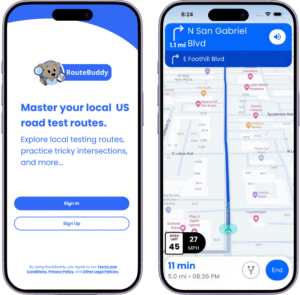
Knowing the test is half the work. Practicing the roads around the center is the other half. RouteBuddy helps you practice the roads commonly used around your test center before test day. It draws on driving instructor input and route pattern data, not PennDOT records.
Here’s what the app offers:
- Turn-by-turn voice navigation, so you can focus on driving instead of directions
- Mock exam simulation for a realistic run-through before the real thing
- Map previews of the roads near your test center
- Practice for tricky junctions and intersections, the spots learners tend to struggle with
- Apple CarPlay and Android Auto support, so it works right through your car’s display
RouteBuddy is subscription-based. It’s available on the Apple App Store and Google Play Store. It won’t ever claim to show you the official or guaranteed route for Philadelphia, because that doesn’t exist. What it gives you instead is a practical way to practice the roads and junctions your examiner is likely to use.
Final Thoughts
So is the Philadelphia Driving Test Route hard to pass? PennDOT gives no pass rates, but it does tell you what the test involves and what can fail it. Practice parallel parking, use your turn signals, bring your original documents, and check your car. Nobody can hand you the exact route, but steady practice puts you well ahead of guessing blind.