
A published checklist, and Georgia’s Department of Driver Services (DDS) makes it public. Examiners look at parking within 18 inches of the curb, backing about 50 feet while looking behind you, signals and stops before crosswalks, and safe following, passing, and yielding. They also expect both hands on the wheel and no chat, because they’re busy giving instructions and recording your score. The Conyers Driving Test Route starts from the DDS Conyers Customer Service Center at 2206 Eastview Parkway NE, Conyers, GA 30013. Here’s DDS’s own list, skill by skill, for learners of any age.


What Examiners Look For
What do examiners look for at the Conyers Driving Test Route?
DDS’s Test and Exams page says this about the Road Skills Test: “the following is expected.” Its list covers parallel parking, backing, stopping for signs and signals, a turnabout, smooth clutch use in a standard transmission, approaching corners, yielding, turning, passing, following, and posture. The next sections give DDS’s wording for each. See DDS’s test and exam information page.
How do examiners check parking and backing at the Conyers Driving Test Route?
DDS’s list is specific:
- Parallel parking. Park midway between two standards, so your car is less than 18 inches from the curb.
- Backing. Back about 50 feet, at a slow speed, as straight and smooth as possible. Turn your head and look back at all times.
- Turnabout. Turn your car around in a narrow space, using two-, three-, or five-point turns.
DDS’s older 2023-2024 manual adds measurements, such as a 22 by 10 foot parallel parking space and backing at no more than 10 mph.
What do examiners look for at signs, corners, and turns?
DDS lists four expectations here. At signs and signals, give the proper hand or brake signal, approach in the proper lane, and stop before the pedestrian crosswalk. Stay stopped until you can move through safely. At corners, be in the proper lane and look in both directions. For turns, get in the proper lane and signal an adequate distance before the turn. When yielding, give the right-of-way to pedestrians, motor vehicles, bicyclists, and anyone else who moves into the intersection before you.
How do examiners check following and passing?
DDS says to look ahead and behind before passing, so you can pass safely without interfering with other traffic. For following, it says not to drive close behind other cars. DDS gives a counting tip. When the car ahead passes a reference point, like a telephone pole, count “one-thousand-one, one-thousand-two.” If you reach the same spot before you finish counting, you’re following too closely.
What about posture, talking, and the clutch?
DDS says to keep both hands on the steering wheel and not to rest your elbow on the window. It also says not to try to carry on a conversation with the examiner, who will be busy giving instructions and recording your score. If your car has a standard transmission, DDS says you must perform a smooth and correct shift.
What do examiners check about the car for the Conyers Driving Test Route?
DDS says the Road Skills Test requires a vehicle with valid liability insurance, registration, and a safety inspection. You must know hand signals if turn signals are absent, and the license plate can’t be expired. DDS’s road test page adds that you bring a paper copy of the registration and a current, valid insurance card. For a rental, your name must be on the rental agreement. See DDS’s road test page.
How the Score Works
How do examiners score the road test?
DDS’s manual says you need a minimum score of 75% to pass a Class C or D road test. DDS’s Test and Exams page places that rule under the traditional test, and it says the examiner reviews your score sheet and discusses the results at the end. Point values for each skill aren’t listed on DDS’s pages, and neither is the scoring method for a virtual test. In a virtual test, the examiner works remotely through a dual-facing camera and a hands-free cellular device. The manual cited here is DDS’s 2023-2024 edition. See DDS’s continued testing page.
What happens if learners don’t pass?
DDS’s current retesting policy says to wait 1 day to retest after failing the Knowledge Exam or Road Skills Test, and 7 days after a second failure. A 30-day wait applies if you fail the Road Skills Test because of an accident or traffic violation. All retests require an appointment and payment of the permit fee.
Booking and the Center
How do learners book the Conyers Driving Test Route?
DDS requires appointments for road tests only, and it offers an online appointment system. Walk-ins aren’t accepted for road tests. DDS says to submit its online License/ID/Permit Form before you visit, and to schedule your road test appointment after submitting your information. The form information stays on file for 60 days. There’s no charge for non-commercial road test appointments, according to DDS. A licensed driver aged 21 or older must come with you. See DDS’s appointments page.
Where is the Conyers Driving Test Route site?
DDS’s Conyers Customer Service Center serves Rockdale and is at 2206 Eastview Parkway NE, Conyers, GA 30013. DDS’s page lists Non-Commercial Road Test among its services. It lists hours as Tuesday through Friday, 8:00 a.m. to 6:00 p.m., and Saturday, 8:00 a.m. to noon, closed Sunday and Monday. Confirm the hours on DDS’s page before you go. See DDS’s Conyers location page.
Preparing and Staying Calm
Are there specific roads I should focus on for the Conyers Driving Test Route?
Nobody can guarantee which streets you’ll get. Treat any source that claims otherwise with caution, since the examiner chooses the route. Some websites sell sets of “routes” for test centers. Those are not DDS information. Based on instructor input and route pattern data, tests from this center reasonably draw from roads around Eastview Parkway. Steady, consistent driving matters more than guessing the route in advance.
I get nervous before driving tests. How can I calm down before my Conyers appointment?
Plan your trip ahead of time so you arrive calm. Pack your documents the night before. Sit in the car for a minute before the test starts. Run through your mirrors, seat position, and controls. A warm-up routine before every practice drive can carry that calm into the test. If you fail, remember that you can retest after DDS’s waiting period.
How RouteBuddy Can Help You Prepare
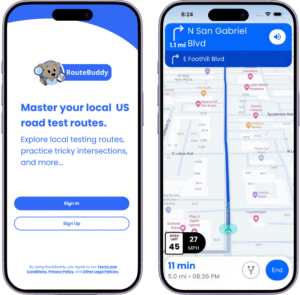
DDS’s checklist is short, so you can practice every item. RouteBuddy helps you practice the roads commonly used around your test center before test day. It draws on driving instructor input and route pattern data, not DDS records.
Here’s what the app offers:
- Turn-by-turn voice navigation, so you can focus on driving instead of directions
- Mock exam simulation for a realistic run-through before the real thing
- Map previews of the roads near your test center
- Practice for tricky junctions and intersections, the spots learners tend to struggle with
- Apple CarPlay and Android Auto support, so it works right through your car’s display
RouteBuddy is subscription-based. It’s available on the Apple App Store and Google Play Store. It won’t ever claim to show you the official or guaranteed route for Conyers, because that doesn’t exist. What it gives you instead is a practical way to practice the roads and junctions your examiner is likely to use.
Final Thoughts
So what do examiners look for at the Conyers Driving Test Route? DDS’s published checklist: parking, backing, signals and stops, corners, turns, yielding, passing, following, and posture. Practice each item until it feels routine. Nobody can hand you the exact route, but steady practice puts you well ahead of guessing blind.