
Most learners assume Bishop DMV Driving Test Route will be simple because the town is small. That’s only half true. The office on West Line Street sits close to US-395, so routes often blend quiet residential streets with a stretch of open highway driving, which catches people off guard more than the town’s size suggests. Here’s what to actually expect, and where learners tend to trip up.
What Happens During the Bishop Driving Test
What can I expect from Bishop DMV Driving Test Route on test day?
Your test starts inside the DMV office at 1115 West Line Street. An examiner checks your paperwork and vehicle, then picks the route for the day. You can look over the California DMV’s driving test overview if you want a general sense of the process beforehand. The California DMV doesn’t publish official test routes for any city, Bishop included, so there’s no way to know the exact route in advance. What you can do is practice the type of roads most likely to come up, based on local route pattern data.
Why do learners underestimate Bishop DMV Driving Test Route?
Because Bishop looks small on a map, but it sits right on US-395, a major Eastern Sierra route. Test routes near the office can include a stretch of this highway alongside the quieter residential grid closer to town. Drivers who’ve only practiced on slow neighborhood streets sometimes get caught off guard by the speed and merging that highway sections require. It’s not that the test is unusually hard; it’s that the road mix is wider than people expect from a small town.
Preparing for Your Test
How should I prepare for Bishop DMV Driving Test Route before my appointment?
Practice needs to cover both ends of that road mix, not just one. A focused list works better than driving around aimlessly:
- Practice driving near 1115 West Line Street at different times of day
- Rehearse three-point turns and parallel parking on quiet residential streets
- Get comfortable merging onto US-395 and handling higher-speed traffic
- Drive a mix of slower town streets and open highway stretches
- Read through the California Driver Handbook for right-of-way and speed limit rules
Varied practice tends to beat one polished run-through every time.
Are there specific roads I should focus on for Bishop DMV Driving Test Route?
Nobody can guarantee which roads you’ll get, and any source claiming otherwise should be treated with caution, since the DMV doesn’t release this information. Based on instructor input and route pattern data, Bishop tests reasonably draw from the residential streets near West Line Street along with sections of US-395. It’s worth practicing highway merging specifically, since that’s the part of the test many learners in smaller towns get less exposure to during everyday driving.
What are the most common mistakes test-takers make on Bishop driving routes?
Misjudging merge speed onto US-395 is the big one, and examiners notice it quickly. Other frequent issues include:
- Forgetting to check mirrors before changing lanes
- Rolling stops at intersections with limited visibility
- Driving too cautiously on the highway stretch, which can look like hesitation
- Poor speed control when transitioning from town streets to open road
- Wide, poorly positioned right turns
Most of this comes down to nerves rather than a lack of skill. Practicing the actual road mix tends to fix it fast.


Managing Nerves and Expectations
I get nervous before driving tests. How can I calm down before my Bishop DMV appointment?
Show up early and stick to a routine. Familiarity beats willpower when it comes to nerves. Get to 1115 West Line Street at least fifteen minutes ahead of time so you’re not rushing. Sit in the car for a minute and run through mirrors, seat position, and controls in your head. Doing the same warm-up before every practice drive tends to carry that same calm into the actual test.
What do examiners actually look for during Bishop DMV Driving Test Route?
Steady, predictable driving, not a flawless run. Examiners check your observation habits, signal use, speed control, and following distance. They pay close attention to how you handle the shift between town streets and higher-speed roads, since that’s where confidence tends to waver. They’re checking whether you drive like a licensed, independent driver would, not whether every maneuver is textbook perfect.
Is there a published pass rate for the Bishop DMV office?
No. The California DMV doesn’t break pass rate data down by office. If you see a specific number floating around for Bishop, treat it as unverified. The DMV’s own site has general statewide statistics if you want something reliable. Practicing the local roads will do more for you than chasing a number nobody can confirm anyway.
Test Day Logistics
What should I bring to my Bishop DMV Driving Test Routes appointment?
Your learner’s permit, proof of insurance, vehicle registration, and a car that’s roadworthy. Brake lights, turn signals, and a current registration sticker all need to work. Give the car a once-over the night before your appointment at 1115 West Line Street, since a mechanical issue on the day can get you rescheduled. You can check office hours through the California DMV office locator as well. A tidy car tends to help drivers feel a bit more settled too.
Can I retake the test if I don’t pass on my first attempt at Bishop DMV Driving Test Route?
Yes, and plenty of learners do. The DMV will tell you what to work on, and you can rebook once the required waiting period passes. Most people use that gap to focus on their weak spots, whether that’s highway merging, parking, or general road confidence. A first attempt that doesn’t go well is still useful information for the second one.
How RouteBuddy Can Help You Prepare
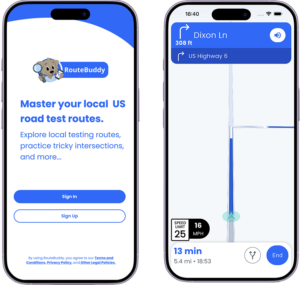
Knowing the roads most likely to come up on your test is one of the most useful things you can do before your appointment, especially somewhere like Bishop where the road mix is wider than expected. RouteBuddy is built around exactly that. It draws on driving instructor input and route pattern data, not DMV records, to help you practice the roads commonly used around your test centre.
Here’s what the app offers:
- Turn-by-turn voice navigation, so you can focus on driving instead of directions
- Mock exam simulation for a realistic run-through before the real thing
- Map previews of the roads near your test centre
- Practice for tricky junctions and intersections, the spots learners tend to struggle with
- Apple CarPlay and Android Auto support, so it works right through your car’s display
RouteBuddy is subscription-based and available on the Apple App Store and Google Play Store. It won’t ever claim to show you the official or guaranteed route for Bishop, because that doesn’t exist. What it gives you instead is a practical way to practice the roads and junctions your examiner is likely to use.
Final Thoughts
So what do learners get wrong about Bishop DMV Driving Test Routes? Mostly that a small town means an easy test. The mix of quiet streets and open highway is what actually catches people out, not the town itself. Practice both sides of that mix, know the common mistakes, and go in with a clear head. Nobody can hand you the exact route, but knowing the pattern puts you well ahead of guessing blind.