
The headline: one of Northern Ireland’s best pass rates
Armagh’s numbers deserve their reputation. Figures compiled from DVA and Department for Infrastructure data have repeatedly placed Armagh among the top-performing test centres in Northern Ireland — rolling yearly averages above 60% have been reported, against an NI average in the mid-50s, and individual quarters have run higher still. Local press has covered Armagh as one of the best places in the north to sit a test.
Why? The usual suspects behind strong rural-city numbers: traffic that gets busy but rarely gridlocks, a compact and learnable road network, and a candidate pool dominated by locals who trained on the actual roads. None of it softens the marking — the same DVA standard applies at every centre — but it does mean thorough local preparation converts to passes at an excellent rate in Armagh. For the current figures, check the DVA’s published statistics via nidirect and the Department for Infrastructure’s quarterly driver testing reports.


Where is the Armagh driving test centre?
The centre is at 47 Hamiltonsbawn Road, Ballynahome More, Armagh BT60 1HW, on the A51 heading south-east out of the city. It’s a combined DVA site — driving tests and MOT vehicle tests share the premises — so expect a steady flow of cars, vans and the odd lorry arriving for vehicle testing around your slot. Treat the site itself as live traffic: slow, scanning, and patient from the moment you arrive.
Armagh serves candidates from the city and a wide rural hinterland: Keady, Markethill, Richhill, Hamiltonsbawn, Milford, Loughgall, Middletown and the villages between. Arrive at least 15 minutes early with your provisional licence, in a car with L-plates front and rear.
Are Armagh driving test routes officially published?
No. The DVA doesn’t publish official Armagh driving test routes or routes for any Northern Ireland centre, and examiners vary routes on the day. Local instructors have documented a consistent set of variations, all drawing on the same compact network: the radials, the city core, the estates and the rural fringe.
Armagh’s network is small enough that a few weeks of focused practice can cover essentially all of it — which is precisely why prepared local candidates pass at such high rates. Don’t memorise one route; learn the whole picture. That’s the model Routebuddy is built on: every documented variation, drivable turn by turn, until the entire city feels familiar.
The roads that make up the Armagh driving test routes
| Road / area | Type | What it tests |
|---|---|---|
| Hamiltonsbawn Road (A51) & the centre exit | Radial road shared with MOT traffic | Moving off, observation, junctions |
| Portadown Road (A3) | The city’s busiest approach | Progress, mirror routine, right turns |
| Newry Road (A28) & Killylea Road | Radials with faster rural stretches | Speed transitions, overtaking judgement |
| Moy Road & Loughgall Road | Northern radials | Junction discipline, building to open-road speed |
| Cathedral Road & the city core | Compact centre streets | Positioning, pedestrians, tight lanes |
| The Mall (East and West) | One-way circuit around the historic green | Lane discipline, one-way awareness, parked cars |
| Scotch Street, English Street & the city hills | Genuinely steep urban streets | Hill starts, clutch control, close-quarters traffic |
| Residential estates off the radials | Quiet housing streets | Manoeuvres, clearance, meeting traffic |
| Rural fringe roads | Narrow, hedge-lined country roads | Appropriate speed, position, cooperation |
A typical Armagh route runs around 40 minutes of driving — out one radial, a rural or estate loop, back through the city core past the Mall, and home along another radial. The variety-per-kilometre is high: you can meet a steep hill start, a one-way circuit and an 80 km/h-style rural bend inside ten minutes.
The most common fail spots on Armagh driving test routes
- The hills. Armagh is famously built on hills, and its test uses them. Hill starts here are not a formality: expect to stop and move off on genuinely steep streets like Scotch Street or on sloped estate corners, sometimes with traffic close behind. Rollback is the classic Armagh fault — make clutch-and-brake control on gradients your first practice priority.
- The Mall one-way circuit. The handsome green at the city’s heart is ringed by a one-way system with angled parking and pedestrians crossing to the park. Wrong-lane positioning, late awareness of the one-way flow and conflicts with reversing parkers are the standard faults. Walk it once, then drive it until it’s automatic.
- The Portadown Road. The busiest corridor in and out of the city — right turns across it, roundabout entries and keeping reasonable progress in its traffic are all regular test material.
- Rural bends at “legal” speed. The radials shed their footpaths quickly, and hedge-lined bends follow. The limit may allow more than the road does; driving the number into a blind bend is one of the fastest serious faults in this catchment. Northern Ireland’s learner ceiling of 45 mph applies everywhere regardless.
- The junction angles of the city core. Old streets meet at odd angles with short sight lines. Stop first, then creep for vision — rolling out for a better view is marked, not rewarded.
- The estate manoeuvres. The reversing manoeuvre and any turn-in-the-road happen in the quiet estates off the radials, frequently on cambered or sloping corners with parked cars. Kerb contact and thin observation are the usual entries on the sheet.
- The shared site at the start and finish. MOT customers, vans and trailers move through the same premises. Tests have been soured in the first and final 100 metres — stay deliberate until the handbrake is on.
How the DVA driving test is marked
Northern Ireland’s practical test is run by the DVA and follows the UK format — different from the RSA test over the border, so mind the terminology if you’re comparing. At Armagh you’ll get:
- An eyesight check — a number plate read from 20.5 metres; failure ends the test immediately.
- Vehicle safety questions — one “show me” and one “tell me”.
- Around 40 minutes of driving, including an independent driving section following traffic signs or directions.
- One reversing manoeuvre — parallel park, bay park or reverse around a corner — plus a possible emergency stop.
Faults come in three grades: driving faults (16 or more fails the test), serious faults and dangerous faults (one of either is an automatic fail). Armagh’s terrain writes its own fault profile: control faults on the hills, position faults on the one-way circuit, and speed-judgement faults on the rural bends. The marking standard on Armagh driving test routes is identical to every other DVA centre in Northern Ireland — the network is just more forgiving to well-prepared candidates.
After passing, Northern Ireland’s restricted-driver rules apply: R-plates for one year, with a 45 mph maximum throughout.
How to practise the Armagh routes effectively
- Hills first. Find the steepest streets and corners on the network and drill starts until rollback is impossible — with a car waiting behind, at least once.
- Loop the Mall. The one-way circuit from every entry, watching lane choice and the angled parkers, until it holds no surprises.
- Work the radials in pairs. Out the Portadown Road, back the Moy Road; out the Newry Road, back the Hamiltonsbawn Road — building the transitions between urban and rural speeds.
- Do rural bends deliberately. Practise reading hedge-lined bends and holding position on unmarked stretches, and get comfortable meeting wide farm traffic calmly.
- Manoeuvre on slopes. Armagh’s estates rarely offer a flat corner — practise the reverse and turnabout on cambers and gradients.
- Rehearse the shared site. Arrive, park, and exit the Hamiltonsbawn Road premises a few times at MOT-busy hours.
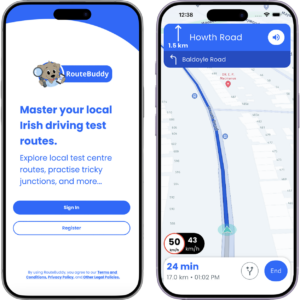
- Finish with full 40-minute mock tests from the centre, including an independent-driving section following signs. Routebuddy’s Armagh driving test routes let you drive every documented variation turn by turn until the whole city — hills, Mall, radials and lanes — is home ground. See the Routebuddy app for turn-by-turn practice.
Practise legally: in Northern Ireland a learner must be supervised by someone at least 21 who has held a full licence for the category for at least three years, L-plates must be displayed front and rear, the 45 mph limit applies at all times, and motorways are prohibited.
Booking your test and what to bring
Book through the DVA’s practical test service on nidirect. Armagh’s waiting times are often friendlier than Belfast’s, but they move with demand — check the booking system regularly for cancellations.
On the day: your provisional licence and a roadworthy, insured car with L-plates front and rear that meets the DVA’s test vehicle requirements. Non-compliant vehicles mean a cancelled test and a lost fee — check the requirements on nidirect the week before.
Frequently asked questions
Where is the Armagh driving test centre?
At 47 Hamiltonsbawn Road, Ballynahome More, Armagh BT60 1HW — a combined DVA driving test and MOT centre on the A51 on the south-eastern edge of the city.
What is the pass rate at Armagh test centre?
Consistently among Northern Ireland’s best. Figures compiled from DVA/DfI data have shown rolling yearly averages above 60%, against an NI average in the mid-50s. Check the DVA’s current statistics via nidirect for the latest figures.
Why is Armagh’s pass rate so high?
The marking standard is the same as everywhere in Northern Ireland. Armagh’s advantages are a compact, learnable network, manageable traffic and a locally-trained candidate pool. Prepared candidates convert well — the hills and rural bends still catch the underprepared.
What is the hardest part of the Armagh driving test?
The hills. Armagh’s steep city streets make hill starts and low-speed clutch control genuinely demanding, with the Mall’s one-way circuit and hedge-blind rural bends close behind.
How long is the driving test in Armagh?
Around 40 minutes of driving, plus an eyesight check, one “show me” and one “tell me” vehicle safety question, an independent driving section, and one reversing manoeuvre with a possible emergency stop.
What speed can a learner driver do in Northern Ireland?
A maximum of 45 mph at all times, whatever the posted limit — and the same ceiling continues for a year after passing, while you display R-plates as a restricted driver.
Where are the manoeuvres done on the Armagh test?
In quiet residential estates off the main radial roads, frequently on sloping or cambered corners — so practise your reversing manoeuvres on gradients, not just flat ground.
Can I practise the exact route I’ll get on the day?
No — examiners vary routes deliberately. Practise all the documented variations rather than memorising one. That’s the approach Routebuddy takes to Armagh driving test routes: every documented variation, drivable turn by turn.
This guide is published by Routebuddy as an independent resource for learner drivers and is not affiliated with the Driver & Vehicle Agency (DVA) or the Department for Infrastructure. Route details reflect roads commonly reported by local instructors and learners; actual test routes vary at the examiner’s discretion. Always verify current rules, fees and requirements on nidirect.gov.uk. For the city-centre equivalent, see our Belfast (Balmoral Road) guide.
